11. Roberto Matta
Back11. Roberto Matta
Audioguide
Roberto Matta was born in Santiago de Chile in 1911. He trained in architecture and worked for years in the studio of Le Corbusier, becoming one of the leading representatives of surrealist painting.
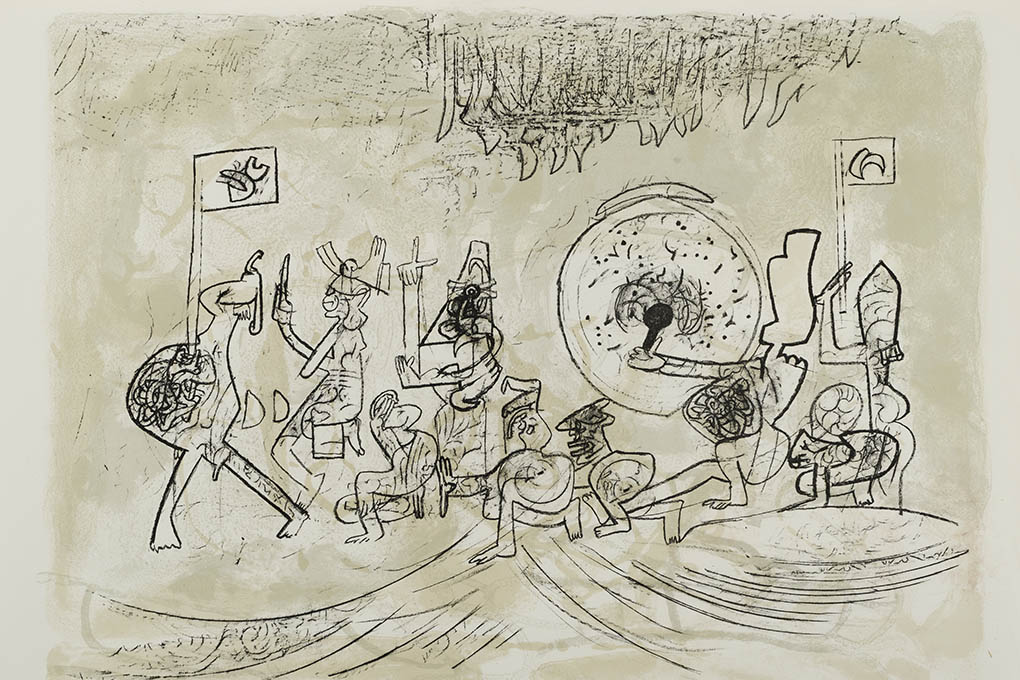
With this work, Matta pays homage to Jorge Zalamea's 1952 text El Gran Burundún-Burundá ha muerto (The Great Burundún-Burundá has died), in which he criticizes the dictatorial Colombian government. Under the same title, Roberto Matta created these seven lithographs, edited by Carmen Waugh, to denounce the 1973 assault on the democratic Chilean government of Salvador Allende by the dictator Augusto Pinochet.
A funeral procession is observed with musical instruments and symbols reminiscent of pre-Columbian American cultures. José María Moreno Galván wrote about Matta in the magazine Triunfo:
"Everyone knows that Matta is a surrealist. One of the few men - in the world - who could provoke the transformation of surrealism without ceasing to be a surrealist. The great sin of the first surrealism was to have confused reality with representation, and when it pretended to reach a super-reality, it only reached super-representation. Surrealism was still bound by the dictatorship of the image... Until Matta. What has Matta done? Matta has overflowed the image...with imagination."