9. Manolo Millares
Back9. Manolo Millares
Audioguide
Manolo Millares was born in Las Palmas de Gran Canaria in 1926 and is one of the most influential artists in the plastic revolution in Spain in the fifties and sixties. He began his contact with art through Neolithic drawings and the Guanche culture.
His childhood was marked by the consequences for his family, sympathizers with the Republican Left, of the military coup of 1936. For this reason, his work is related to the anti-Franco cultural resistance, as well as to the artistic revolution of Spanish informalism. In 1955 he settled in Madrid, where his career was linked to exhibitions and the El Paso group.
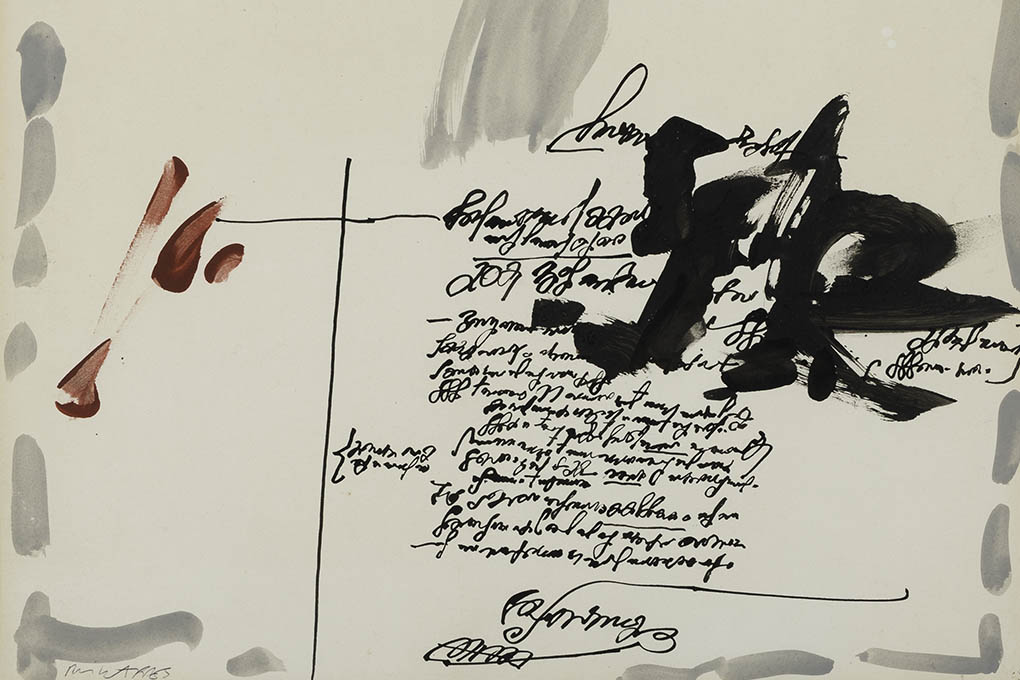
In the sixties, Millares introduced some symbols in his works. In this untitled piece, he simulates calligraphy from the sixteenth and seventeenth centuries. He includes strokes annulling part of the text, alluding to censorship in the times of the Holy Inquisition and Franco's Spain.
Manolo Millares was one of José María Moreno Galván's best friends, and in the magazine, Triunfo, the critic said of the artist:
"Millares is a seeker of footprints of the past and a maker of footprints of the present. As an amateur archaeologist, he loves beautiful forms; as a painter, he is a disparager of the beauty of form."