6. Josep Guinovart
Back6. Josep Guinovart
Audioguide
Josep Guinovart was born in Barcelona in 1927. He was nine years old when the Spanish Civil War broke out, an event that had a decisive influence on him. He received no artistic training and had no teachers in the influential sense of the term, although he attended the Schools of Arts and Crafts in Aribau Street and the Lonja de la Lonja.
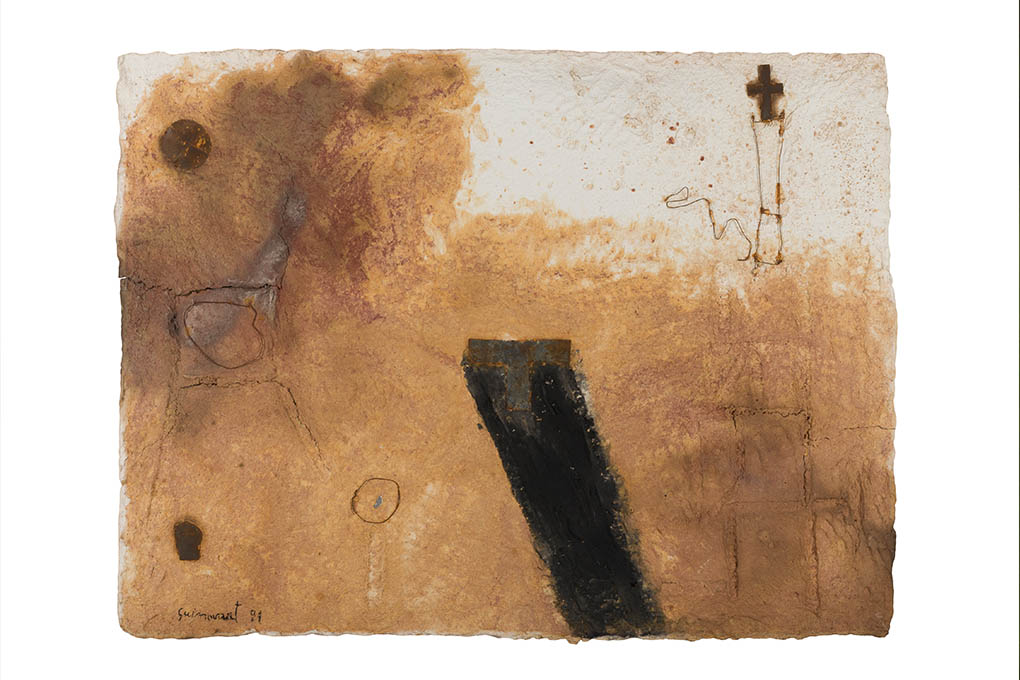
The works that are part of the museum's collection, created in 1991, were born at a time of artistic maturity and maximum recognition of the author.
They are two pieces made on handmade paper where Guinovart shows his interest in the material, textures and the subtle figurative appearance of some symbols. These appear in his works as drawings that can be found on any street wall. The critic, José María Moreno Galván, writes about Guinovart's work in the magazine, Artes, in 1970:
"The viewer somehow senses that there is something circulating through the blood of that painting that also circulates through his own blood; that there is an element in the life of the work that is also part of his own life. It is not necessary for that attachment to be rationalized. It is enough that it occurs, because, in its obscure mechanism, the most primary and elementary way of understanding the work of art has been organized: to understand is to feel understood within it."