5. Antoni Tàpies
Back5. Antoni Tàpies
Audioguide
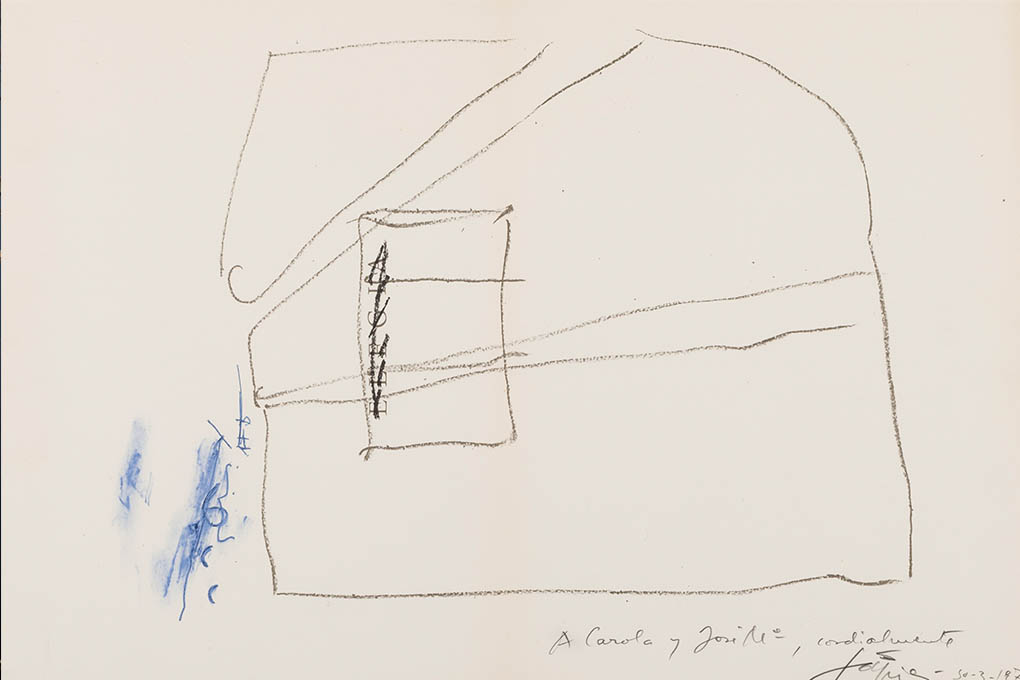
Antoni Tàpies was born in Barcelona in 1923. A self-taught artist, he created his own language in line with the avant-garde of the twentieth century, starting along the lines of surrealism. The key aspects of his work are the relevance and value he gives to humble materials, as well as a progressive tendency towards abstraction.
In the 1940s he became a co-founding member of the magazine, Dau al Set, the axis of the Catalan side of Informalism. Influenced by Joan Miró and Paul Klee, Tàpies experimented in his works with geometrical elements.
During the sixties he incorporated new symbolic elements, such as the cross. In this piece called ELEGÍA (ELEGY) the letter T appears, which alludes to the initials of his name and surname, as well as the name of his wife, Teresa, representing the union between them.
In the magazine El Alcázar, José María Moreno Galván writes about him:
"Tàpies expresses an inner reality. I have purposely said “reality," with which, by the way, he also frees that art conventionally called "abstract" from the burden of an alleged purism of form. Almost all abstract art, but especially the abstraction of Tàpies, ceases to be naturalism; but it is a realistic art."